Retread: 10 Reasons You Need a College Degree
"In my own life, grit has helped me more than my good looks, incredible smarts, and..."

Nota Bene: This blog post was first published in 2016. Most of these points are still relevant 10 years later. Enjoy!
Last month my blogging buddy Mr. Groovy was kind enough to write a post highlighting my thoughts on hacking a college degree. It appears that Mr. Groovy and I are both "freedomists" with substantial rebellious streaks in us.
While it's easy to be down on higher education with its ridiculous tuition rates for degrees of limited utility, there are still many reasons to earn a college degree. Here are ten reasons you should consider pursuing an undergraduate degree:
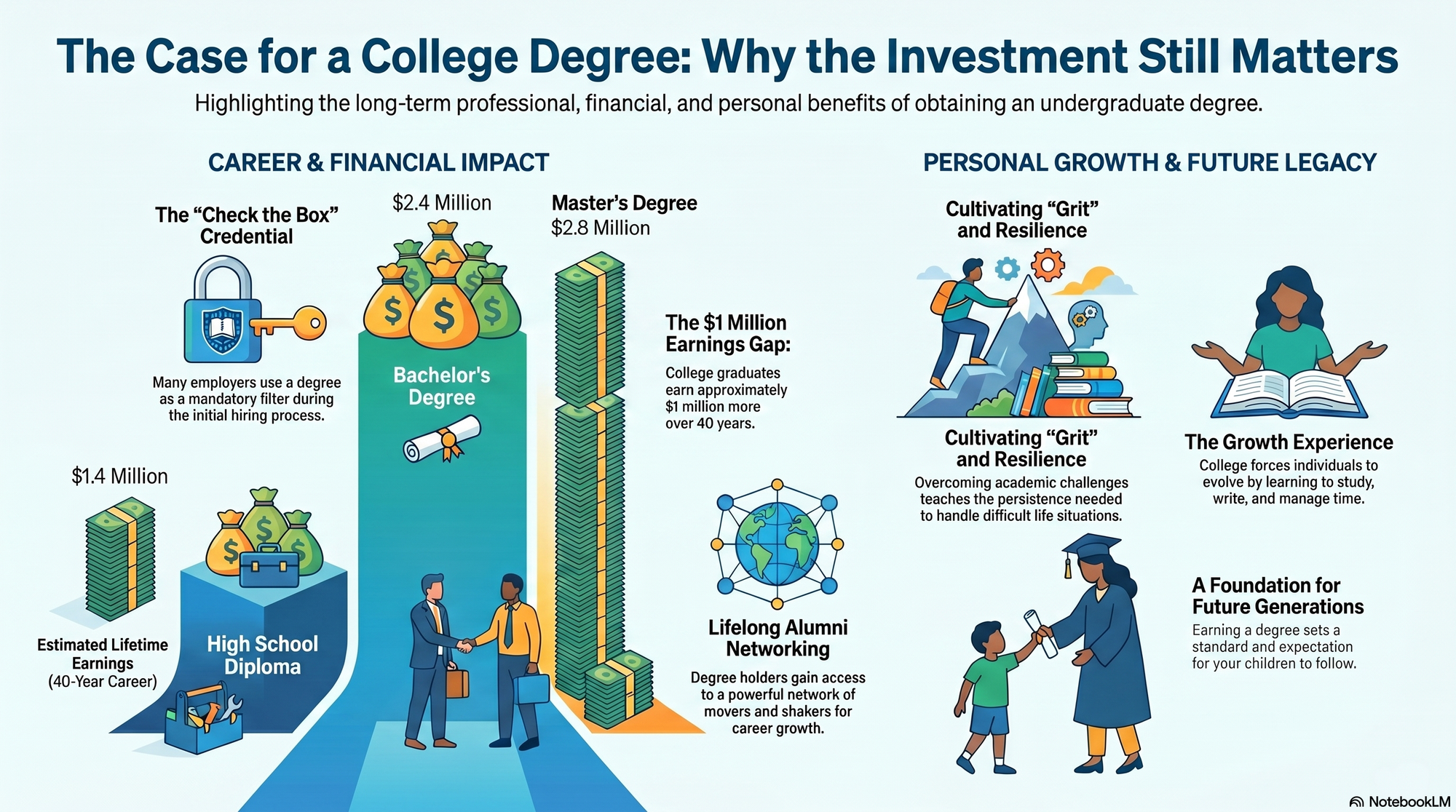
- Credential * Many jobs require a college degree (any degree!) as a minimum requirement. Like it or not, a college degree serves as a filter during the interview process. Once you earn your degree in physics or P.E., the interviewer can "check the box" on your job application and continue on with the interview. Conversely, the lack of a degree is often used against you during the hiring process. As soon as you earn your college degree, those days will be over.
- Graduate School * An undergraduate degree affords you the opportunity to attend graduate school. (I know, I know...once you're done with college, you're never going back to school again. Yeah, I remember saying that about three graduate degrees ago.) At some point, it's likely that you'll want to return to school for a specialized degree. Going to graduate school without an undergraduate degree is virtually impossible, so my advice is to knock out your undergrad degree as soon as possible.
- Bragging Rights * A college degree gives you bragging rights among your “degree-less” peers. Okay, this is a really lame reason to go to college, but it's true that a college degree will increase your social status. Depending on where you live, earning a college degree can be an infrequent accomplishment or a normal occurrence. For example, Huntsville, Alabama has a large percentage of residents with college degrees (50%+) while other areas have ZERO college graduates. So, in Huntsville a degree would be a necessity, but a degree in some areas would make you highly credentialed.
- Growth Experience * When I arrived at college back in 1982, I remember thinking to myself, "Self, you're not only a basketball superstar, but you're also smarter than the average bear." It took all of one week of classes to shatter that illusion. I immediately scrambled to learn how to: study, write at the college level, plan for tests and papers, and basically keep my academic ship afloat while playing D-1 basketball. Of course, all these skills had to be learned in addition to tons of academic material. Even my academic disasters were growth experiences. For example, I was terrible at Spanish; I struggled to get C's and barely fulfilled my foreign language requirement. After graduating from college in 1986, I went to Argentina to play basketball. Because of my embarrassing performance in my Spanish classes, I was highly motivated to get my Spanish up to snuff. Eventually, I learned Spanish and became a high school Spanish teacher...oh the irony! In college everyone grows, or they flunk out.
- Focus * A college degree requires a lot of time, physical energy, and mental concentration. At a certain point most individuals grow tired of being students. Finishing your college degree as soon as possible allows you to focus on other aspects of your life such as your: career, marriage, health, and hobbies. Once you have your degree in hand, you won't feel guilty for reading for pleasure, sleeping in with your sweetie, taking a jog, or road-tripping to the beach. Not having that nagging oh-crap-I-have-a-paper-due-tomorrow feeling is priceless.
- Career Network * Attending college will put you in contact with all sorts of interesting people. Many of these people grow up to become movers and shakers who are "good to know" for your career growth. Using your alumni network is an easy, and socially acceptable, way to reach out to people of all walks of life. For example, you could use your alumni contacts to explore job opportunities or career changes. It has been my experience that most individuals are happy and willing to help their fellow alumni. While you may never need to use an alumni network, it is a useful tool to have.
- Role Model * If you want your own children to obtain their college degree, it's best that you lead by example and earn your own degree first. It is my experience that the children of college graduates usually go on to college and earn their degrees regardless of ability and motivation. Thanks to social media I am able to see what my students do after high school. I am often surprised at how many "average" students go on to finish their college degrees. The key component seems to be that these students come from families that expect (and demand) that their children earn college degrees. If your parents went to college and finished, it's likely that you'll do the same. So, when you finish your college degree, you are setting a standard for your own lineage.
- Future Spouse * Some people are fortunate enough to meet their soul mates in college and get married early in life. Because college is full of single people of similar interests, it stands to reason that college is a good place to find a spouse. Even if you don't find the love of your life in college, your college degree will signal to potential mates that you are a serious person who plans for the future. Firm butts and six-pack abs might catch your eye, but a potential spouse with a successful future is irresistible.
- Money * We always hear that college graduates earn more money than high school graduates, but do you know how much more? According to the graph below, it's about $1 million more over a 40 year career ($2.4 million vs. $1.4 million). Individuals with a master's degree earn almost double that of high school graduates over the same time frame ($2.8 million vs. $1.4 million). Earning your college degree is the best way to avoid leaving money on the table. Earning your college degree helps you maximize your income over your working career.
- Grit * In my opinion, learning to "suck it up" and get things accomplished was the greatest lesson of my college experience. On your college degree journey you will take many difficult courses with professors who love their area of expertise. Many of your professors will have high academic expectations that will seem unreasonable or even impossible. You can drop the course and change professors, but at some point you'll have to deal with some truly difficult situations. Don't worry, you will learn how to battle your way through hard courses and challenging professors. Your increased levels of diligence and persistence will serve you well in life. In my own life, grit has helped me more than my good looks, incredible smarts, and infinite social grace…combined!

In spite of my negative feelings towards the educational-industrial complex, those are my reasons why many people would benefit from a college degree. That said, I certainly don't recommend that you take on a boatload of student loan debt to finance your degree. I suggest that you avoid student loans and find some way to hack your degree. It can be done!
To me, the best reasons for going to school were reasons #1, #2, and #5. What were yours? What are some other reasons that I might have overlooked?
Overeducatedly yours,
GB