Minnesota Mirage: Pension Fund Shenanigans
"They are fiduciaries who are effectively flying blind, overseeing a total state investment apparatus worth $146 billion without ever seeing the actual contracts."


Note Bene: I did not write this post; it's 100% AI. I wanted to see how AI would handle these complex and obtuse financial facts. I used to NotebookLM to summarize one PDF source. If you'd like more info on this topic, read Edward Siedle's article: Minnesota Mirage: Sleight of Hand. (Hat tip to Edward, thanks for all you do.)
The Minnesota Mirage: 5 Shocking Truths Hiding in the State’s Teacher Pension Fund
For decades, Minnesota’s educators have been told their retirement is safe, built on the bedrock of a multi-billion dollar pension fund. But a forensic investigation has just pulled back the curtain, revealing that this security is a carefully crafted "mirage."
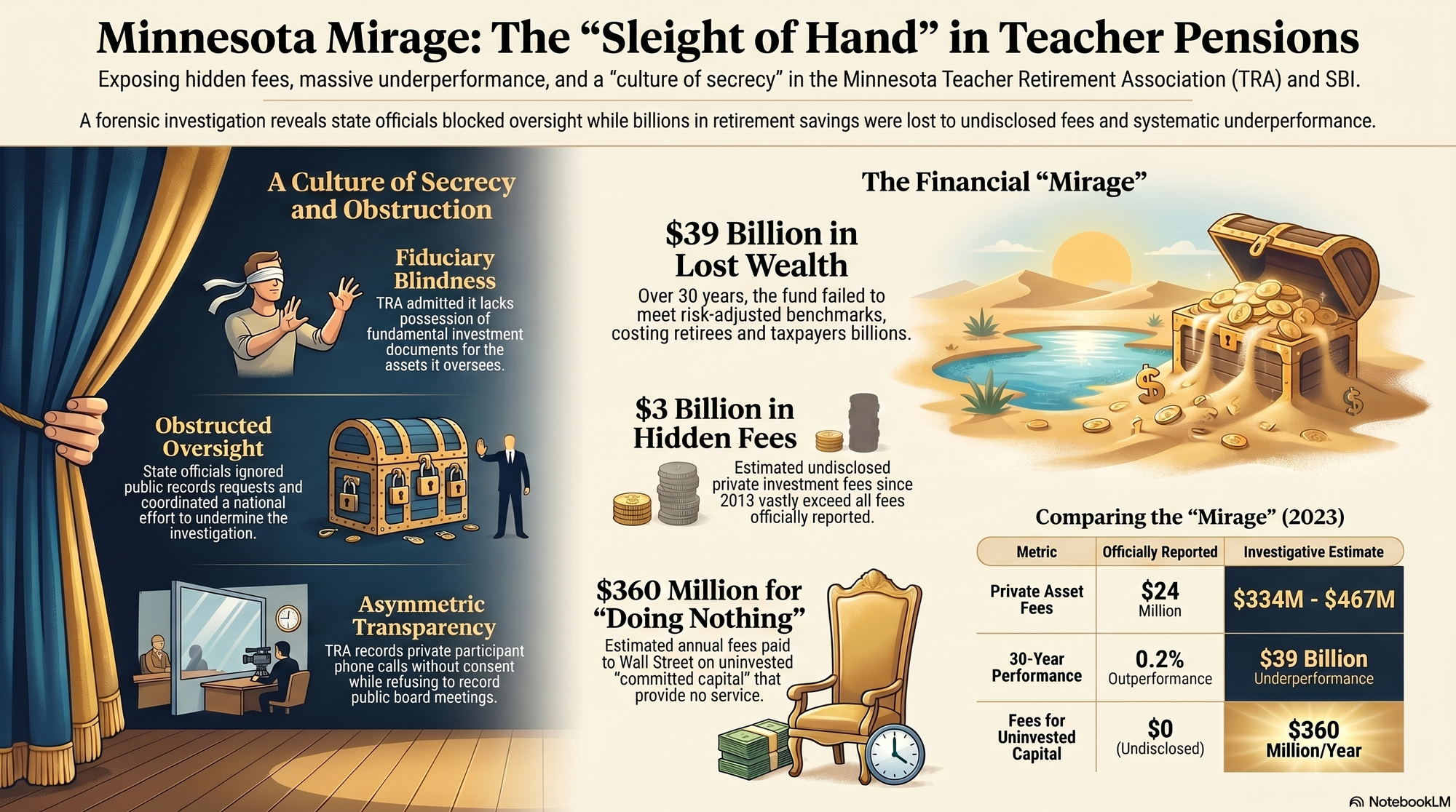
Commissioned and crowdfunded by the Minnesota Educators for Pension Reform, the audit by Benchmark Financial Services, Inc. has exposed a system operating with almost zero transparency. Perhaps the most damning finding is the "Sleight of Hand" regarding governance: the Minnesota Teacher Retirement Association (TRA) Board claims to have "knowledge" of investments, yet they admitted in public record responses that they possess zero fundamental investment documents. They are fiduciaries who are effectively flying blind, overseeing a total state investment apparatus worth $146 billion without ever seeing the actual contracts.
Here are the five most shocking truths uncovered in the investigation.
1. The "0.2% Miracle": A Statistical Impossibility
According to the TRA’s own financial statements, the fund has achieved a feat that defies mathematical logic. The report flagged that the fund claimed to outperform its "Composite Index" by exactly 0.2% over 1, 5, 10, 20, and 30-year periods.
This is a statistical impossibility. The probability of hitting this exact 0.2% outperformance across five distinct periods is 0.0000149—roughly the same odds as being dealt a straight flush in poker. Even more suspicious? This exact "miracle" didn't just happen in 2023; it also occurred in 2020. This suggests a "brazen benchmark bias" where indices are customized to ensure the fund always looks like a winner, regardless of the actual market reality.
Most exhibit significant benchmark bias, meaning the chosen benchmarks underperform ones that, in fact, better represent a fair economic return given observed market exposures and risk characteristics. As a result of benchmark bias, the majority of funds give the impression they are performing favorably compared to passive management, when, in fact, they are underperforming by a wide margin. — Richard Ennis, Founder of Ennis Knupp (now Aon)
2. The Fee Iceberg and "The Aon Factor"
While the TRA officially disclosed only $24 million in fees for 2023, the investigation revealed this is merely the tip of a massive "fee iceberg." The actual fees paid to private equity managers are estimated to be between $334 million and $467 million annually.
The State Board of Investment (SBI) includes an "Important Note" in its reports, claiming that focusing on net returns makes fee disclosure a "distraction." This is nothing short of a fiduciary confession—an admission that officials are intentionally blinding the Board and stakeholders to avoid scrutiny.
Compounding this risk is "The Aon Factor." The consultant used by both the TRA and SBI is Aon, the same firm behind the massive Pennsylvania (PSERS) performance calculation error that triggered FBI and SEC investigations. When consultants have a history of "data corruption" and misleading boards, a $400 million discrepancy in fees isn't just a distraction—it’s a red flag for catastrophic tax consequences.
3. Paying for Nothing: "Zombie Funds" and Committed Capital
Minnesota is currently handing over an estimated $360 million annually to Wall Street for doing absolutely nothing. The SBI pays management fees on "unfunded commitments"—roughly $3.6 billion that has been promised but not yet actually invested. While savvy institutional investors now refuse to pay fees on uninvested capital, Minnesota continues to drain the fund for the benefit of private managers.
Adding to this waste is the presence of "Zombie Funds." The report exposed that 6% of the private equity portfolio is trapped in funds over 12 years old. These "walking dead" funds are notorious for milking management fees long after they should have liquidated. In the world of high-finance forensics, these are major indicators of fraudulent valuations and a refusal to admit losses.
4. The "Squeaky Wheel" Treatment: A Culture of Hostility
The investigation uncovered a disturbing "culture of defensiveness." While the TRA refuses to record its public board meetings—claiming legal concerns—internal documents revealed they secretly record telephone calls with teachers without their consent.
Internal emails show TRA Executive Director Jay Stoffel and his staff panicked by the teacher-led audit, disparaging critical participants as "squeaky wheels" and launching a national effort to undermine the investigation before it even began. This hostility flows from the top: the Chair of the SBI, Governor Walz, oversees $146 billion in assets yet, according to financial disclosures, has never owned a single stock or bond. This lack of market expertise at the highest level of governance has allowed a culture of secrecy to take root.
5. The $39 Billion Price of Underperformance
The final cost of this "sleight of hand" is staggering. When measured against real-world, risk-adjusted benchmarks, the fund’s true performance is revealed. If the TRA had been managed to match a representative passive benchmark over the last 30 years, it would be worth $60 billion today. Instead, it sits at $28.2 billion.
This $39 billion shortfall has left the fund with a 76.9% funding status. Under the federal Pension Protection Act of 2006, this puts the fund squarely in the "Yellow Zone," a designation for "endangered" plans that require a mandatory funding improvement plan.
Conclusion: A Call for Sunshine
The findings of the "Minnesota Mirage" investigation are an indictment of state leadership. Transparency is a zero-cost cure for what ails this fund, yet officials have stonewalled every request for basic documents.
The "disinfectant of sunshine" is being blocked by the very people sworn to protect the retirement of Minnesota’s educators. As a teacher, a taxpayer, or a citizen, you must ask: Who really benefits when the people holding the keys to your retirement are the ones most afraid of what an audit might find?
What did you think of this AI attempt? Was it AI-slop or did it get the job done?
Thanks for reading,
GB